

The Least Bad Thing
A defence of the two-party system, against those who hate it
There is a phrase doing the rounds right now, and I want to talk about it.
“Uni-party.”
If you haven’t encountered it yet, you will. It is shorthand for a feeling spreading across the English-speaking world: that neither of your major political parties truly represents you, that both are captured by the same donors and the same permanent class of technocrats, that whichever way you vote, nothing really changes.
Both parties, the argument goes, are the same party.
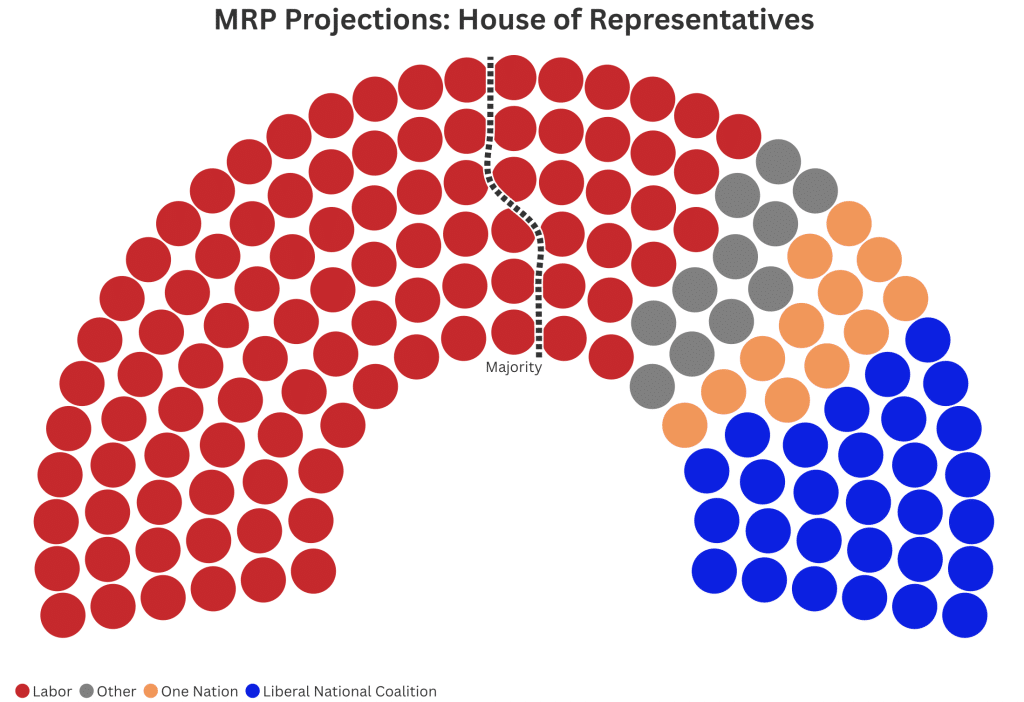
Right now, polling in Australia has Pauline Hanson’s One Nation overtaking a Labor government that has just handed down one of the more substantive budgets in recent memory. In the UK, both the Conservative and Labour parties have experienced a collapse in support so severe that Nigel Farage’s Reform is now a serious contender for government. In the US, the support that Trump has bled is not flowing back to the Democrats. It is pooling somewhere else, in a growing body of people who have concluded that the choice between the two parties is no choice at all.
I understand this. I really do. For what it’s worth, the Albanese government’s recent budget hit my family directly. I am not writing this as someone who has never felt the particular sting of watching a government you half-trusted do something that genuinely hurts you. I know what that feels like.
And yet.
The frustration is real. The diagnosis is wrong.
Let me say plainly: the people peddling the uni-party argument are not wrong that the major parties have disappointed you. They are wrong about what that disappointment means.
Here is the thing about two major parties in a functioning democracy. They are not trying to represent you perfectly. They are not designed to represent you perfectly. They are designed to represent the broadest possible coalition of competing interests well enough that the country holds together.
A party that perfectly represents you has, by definition, already divided the country in half.
This is not a failure of the system. It is the system working exactly as intended.
The two-party structure does something that no multi-party arrangement has managed to replicate at scale. It forces coalitions to form inside the tent, before the election, through primaries and policy compromises and internal factional warfare that you mostly never see. In a multi-party system, those coalitions form after the election, between parties, and this is where small fringe parties acquire power entirely disproportionate to their actual support.
Look at Israel. Look at Italy. Look at Germany, where the SPD governed for years propped up by coalition partners even as its own primary support collapsed, insulated from the electoral punishment that a two-party system would have delivered swiftly and cleanly.
This is the part the proportional representatin advocates never mention. In a proportional system, you can vote a major party down and watch them stay in power anyway, because a small party with 6% of the vote decides it prefers a seat at the table to a seat in opposition. The government you wanted gone is still there. But now it owes its survival not to you, the voter, but to a minor party you may not have voted for and likely cannot remove.
Anyone selling you proportional representation as a cure for the uni-party are, with breathtaking irony, offering you a system where the major parties are even more insulated from your anger than they are now. At least in a two-party system, when you throw the bastards out, the bastards actually leave.
Look at any proportional representation system that has had to govern through genuine crisis and tell me, with a straight face, that the instability those systems produce is a price worth paying for the satisfaction of having a party that more precisely reflects your worldview.
The most stable, wealthy and free societies in recorded history have been overwhelmingly produced by two-party or dominant two-party democratic systems.
It is the same when a party of fringe actors, like Reform, like One Nation and like the Republican party remade in Trump’s image; promise to “drain the swamp” or to “keep the bastards honest” (the Australian equivalent).
I beg you, at least apply the same skepticism to their claims as you would to either of the major parties, and to see if they can convince you they are worthy of the power they would be handed in victory.
Meet your saviours
So who are the people telling you the system is broken beyond repair, and that they, specifically, are the ones to fix it?
In Australia it is Pauline Hanson, who has been in Australian politics for nearly thirty years. Thirty years.
She has never held significant executive power. She has never built anything. She has never fixed a single one of the problems she has spent three decades complaining about. What she has done, with extraordinary consistency and discipline, is locate the precise anxieties of a particular group of Australians and reflect them back in the most inflammatory language available.
In the UK it is Nigel Farage, who has been predicting that he is about to change everything for about as long as Hanson has been predicting the same in Australia. Brexit, the thing he sold as the solution to Britain’s problems, has produced an economy that is measurably poorer, more isolated and less capable of attracting the the investment it needs to grow. Reform UK does not have a costed economic platform. It has a list of things to be angry about.
In the US the situation is more complicated because Trump has actually seized control of one of the major parties, which is a different and more serious problem. But the voters who have abandoned both parties in disgust, who describe the Democrats and Republicans as two wings of the same corrupt bird? They are being sold the same product. Grievance, bottled and labelled as revolution.
None of these people are offering you a better government. They are offering you a better enemy.
The lie at the centre of “uni-party”
When someone tells you both major parties serve the same master, they are usually telling you something true about themselves: that what they want is not available from either party, and they have decided to interpret this as evidence of corruption rather than as evidence that what they want is outside the mainstream.
Sometimes that is a reasonable interpretation. Sometimes the mainstream is wrong, and history is full of moments when the fringe was right and the centre was captured. I am not dismissing that possibility.
But Pauline Hanson is not Rosa Parks. Nigel Farage is not Nelson Mandela. These are not people who have been shut out of power because they were ahead of their time. They are people who have been kept at the margins because the actual work of governing a complex modern society requires compromises that do not survive contact with a grievance-based political identity.
You cannot run a country on resentment. At some point you have to make a budget. And when you make a budget, you will disappoint someone. And when you disappoint someone, you become the new establishment. And the next Farage will be along shortly to tell that disappointed person that you, too, are the uni-party.
Or, worse, the fringe becomes mainstream and political corruption and economic degradation reign supreme, as occurred under Viktor Orbán in Hungary or the Law and Justice party in Poland. Then the new ruling party starts to look for external enemies to blame for stagnation…
This is not a political platform. It is a perpetual motion machine for rage.
The miracle we have forgotten to notice
There is something extraordinary that happens in a functioning two-party democracy every few years, and we have become so accustomed to it that we have almost entirely stopped noticing it.
We throw the bastards out.
Not with violence. Not with a coup. Not with a revolution. We go to a polling booth, or we fill in a form and mail it, and we register our preference, and the government changes. The people who were in power walk out of the building and the people who were not in power walk in. The army does not move. The courts continue to function. The next morning, life continues.
This is not nothing. This is, in the long arc of human history, almost unimaginably rare and precious. The vast majority of people who have ever lived on this earth have never experienced it. Most of them did not get to experience it because their government had efficiently removed the inefficient bureaucratic obstacles that might have allowed them to.
The argument that this system has failed you because the party you voted for didn’t do everything you wanted is like arguing that the parachute is useless because the landing was hard.
Vote the bastards out. Vote the other bastards in.
I want to end with a direct ask.
If you are angry at the government, good. You should be. Anger at the people in power is not a malfunction of democracy, it is the engine of it. The question is not whether your anger is justified. The question is what you do with it.
Here is what I am asking you to consider. Instead of handing your vote to a grievance merchant who has never governed anything and has no intention of ever having to, vote for the major party that is not currently in power. Throw the bastards out. I am entirely with you on that. But vote the other bastards in.
This is not a compromise. It is actually the more radical act.
Governments that change frequently are healthier governments. They are more honest, more careful, more aware that the clock is running. The parties that cycle in and out of power develop something that the permanent protest party never can: an understanding of how the levers actually work, a familiarity with the civil servants who know where the bodies are buried, an institutional memory of what happens when you promise something you cannot deliver. These things matter enormously when a crisis arrives, and a crisis always arrives.
The minor party protest vote feels like a statement. And maybe it is. But a statement is not a government, and you do not always get to make another one. Elections are not guaranteed. Ask the citizens of any country that held one last free and fair election and chose, in their frustration, to hand it to someone who promised to tear the whole thing down.
They are still waiting for the next one.
I’m amazed I hadn’t considered this before. If every group is represented, every group remains in the system, and the dominant majority—supported by an ever-growing collection of smaller minorities—can continue indefinitely.
Additionally, when my ballot paper is crowded with candidates, unless I research and deliberately number every preference myself, the eventual flow of preferences feels opaque to most voters, despite the rules being publicly available.
When the connection between the vote cast and the final outcome becomes increasingly difficult to follow, it’s easy to see why many ordinary voters lose trust and confidence in the democratic process.
On the plus side you raised points I have never really thought about. It is actually your originality that led to me writing this, my first substack response. It is so nice to stumble on great original thinking supported by wonderful writing.
Unfortunately, while I find myself very drawn to your support for the two party system I can’t get past the fact you seem to wilfully ignore the overwhelming evidence that neither the Democratic Party nor the Republican Party come close to representing the interests of the majority of Americans. Thomas Piketty was right when he pointed out that American politics has become a struggle to see which group of elites is in power. The Brahmin Left or the Merchant Right that is currently in power.
This battle is vicious and as it has become absurdly, nakedly, partisan and powerfully driven by corporate and special interest money Americans increasingly identify as Independents or worse, are not voting at all. The correct solution is for both parties to realize they have to abandon their extreme partisan beliefs and replace their elites with Americans who aren’t privileged enough to have the time or resources to make their voices heard.
If the only way to get these desperately needed changes implemented is to not vote or vote for a third party then a major third Party and probably a fourth, fifth, and even sixth Party are inevitable as is Proportional Voting. I would argue they will each have their own elite and the spreading of power will make America a better place to live if they don’t currently belong to the two existing elites.